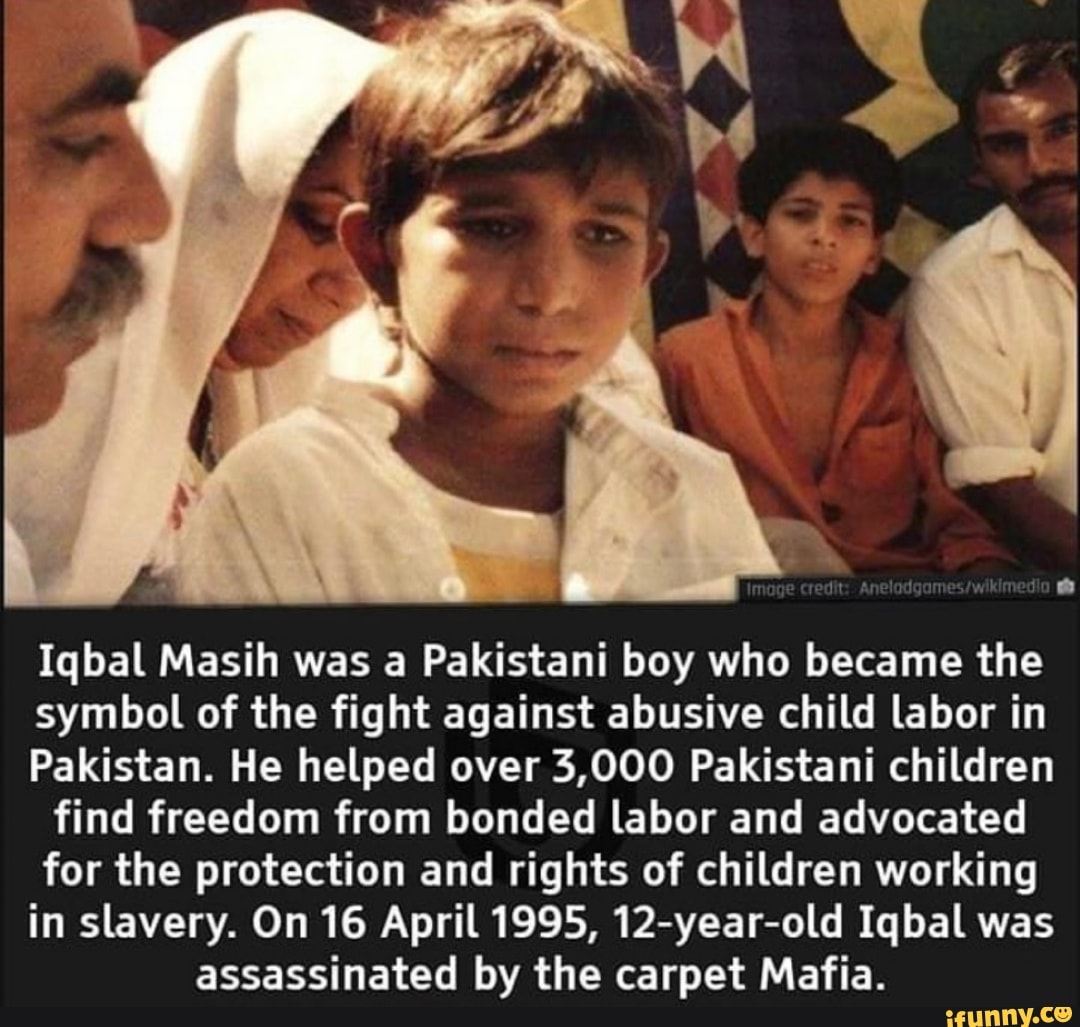

Iqbal Masih was a young Pakistani activist who became a symbol of the global fight against child labor. Born in 1983 in a small village in Punjab, Pakistan, Iqbal's life was marked by hardship and exploitation from a very young age. His story is one of resilience and courage, highlighting the plight of millions of children who are forced into labor worldwide.
The Early Life of Iqbal Masih
Iqbal Masih was born into a family of farmers in the small village of Muridke, Punjab, Pakistan. At the age of four, he was sold into bonded labor by his parents to a carpet factory owner to pay off a debt. This was a common practice in Pakistan at the time, where families, often desperate for money, would send their children to work in factories or workshops to repay debts.
Iqbal spent his childhood in the carpet factory, working long hours under harsh conditions. He was often beaten and malnourished, a stark contrast to the life of a child who should have been in school. Despite these challenges, Iqbal's spirit remained unbroken. He dreamed of a better life and an education, which he saw as his path to freedom.
Escape and Education
In 1992, at the age of nine, Iqbal managed to escape from the carpet factory with the help of a local activist. This escape was a turning point in his life. He was taken to a shelter run by the Bonded Labour Liberation Front (BLLF), an organization dedicated to rescuing and rehabilitating children from bonded labor.
At the shelter, Iqbal received an education for the first time. He quickly excelled in his studies, showing a remarkable aptitude for learning. His experiences in the carpet factory fueled his determination to fight against child labor and to help other children in similar situations. Iqbal became a vocal advocate for children's rights, speaking at conferences and rallies around the world.
Global Advocacy and Impact
Iqbal Masih's story gained international attention, and he became a prominent figure in the global movement against child labor. He traveled to various countries, sharing his experiences and advocating for the rights of children. His speeches were powerful and emotional, often leaving audiences in tears. Iqbal's message was clear: every child deserves the right to an education and a childhood free from exploitation.
In 1994, Iqbal was awarded the Reebok Human Rights Award, which included a cash prize of $25,000. He used this money to establish the Iqbal Masih Foundation, an organization dedicated to rescuing children from bonded labor and providing them with education and rehabilitation. The foundation worked tirelessly to raise awareness about child labor and to lobby for stronger laws and enforcement.
The Legacy of Iqbal Masih
Tragically, Iqbal Masih's life was cut short when he was murdered in 1995 at the age of 12. His death sent shockwaves around the world, and his legacy continues to inspire activists and advocates for children's rights. Iqbal's story serves as a reminder of the ongoing struggle against child labor and the importance of education in breaking the cycle of poverty and exploitation.
Iqbal Masih's impact on the global fight against child labor is immeasurable. His courage and determination have inspired countless individuals and organizations to continue the fight for children's rights. The Iqbal Masih Foundation, now known as the Bonded Labour Liberation Front, continues to work towards the eradication of child labor in Pakistan and around the world.
Iqbal Masih's legacy is not just about his personal story but also about the broader issue of child labor in Pakistan and globally. His life highlights the urgent need for stronger laws, better enforcement, and greater awareness to protect children from exploitation. The fight against child labor is ongoing, and Iqbal's story serves as a powerful reminder of the importance of this cause.
Child Labor in Pakistan
Child labor remains a significant issue in Pakistan, with millions of children forced into work to support their families. According to the International Labour Organization (ILO), there are an estimated 12.5 million children in Pakistan engaged in child labor. These children work in various sectors, including agriculture, manufacturing, and domestic service.
The causes of child labor in Pakistan are complex and multifaceted. Poverty is a primary driver, with many families relying on their children's income to survive. Lack of access to education, cultural norms, and weak enforcement of labor laws also contribute to the problem. The government of Pakistan has implemented various initiatives to address child labor, but progress has been slow.
Some of the key initiatives include:
- National Policy and Plan of Action on Child Labour (2012): This policy aims to eliminate child labor by 2016, with a focus on education, awareness, and enforcement.
- Bonded Labour System (Abolition) Act (1992): This law aims to abolish bonded labor and provide rehabilitation to victims.
- Child Labour (Prohibition and Regulation) Act (1991): This act prohibits the employment of children in hazardous occupations and regulates their working conditions.
Despite these efforts, child labor remains a persistent problem in Pakistan. The government faces challenges in implementing and enforcing these laws, and there is a need for greater coordination and collaboration with civil society organizations and international partners.
Global Efforts to Combat Child Labor
The fight against child labor is a global effort, with various international organizations and governments working together to address this issue. The International Labour Organization (ILO) plays a crucial role in this fight, providing guidelines, standards, and support to countries around the world.
The ILO's Convention No. 182 on the Worst Forms of Child Labour is a key international instrument in the fight against child labor. This convention calls for the immediate elimination of the worst forms of child labor, including slavery, trafficking, and hazardous work. It has been ratified by 187 countries, including Pakistan.
Other international organizations, such as UNICEF and the World Bank, also play important roles in combating child labor. They provide funding, technical assistance, and advocacy to support countries in their efforts to eliminate child labor. These organizations work closely with governments, civil society, and the private sector to address the root causes of child labor and to promote education and economic opportunities for children.
In addition to international efforts, many countries have implemented their own initiatives to combat child labor. For example, the United States has enacted the Trafficking Victims Protection Reauthorization Act, which aims to combat child labor and trafficking. The European Union has also implemented various measures to address child labor in its supply chains.
The Role of Education in Combating Child Labor
Education is a powerful tool in the fight against child labor. It provides children with the knowledge and skills they need to break the cycle of poverty and exploitation. Access to quality education can empower children to make informed decisions about their future and to advocate for their rights.
However, access to education remains a challenge for many children in Pakistan and around the world. Poverty, lack of infrastructure, and cultural norms often prevent children from attending school. In addition, many children are forced to work to support their families, further limiting their access to education.
To address these challenges, there is a need for greater investment in education, particularly in marginalized and vulnerable communities. This includes building schools, training teachers, and providing educational materials. It also involves addressing the root causes of child labor, such as poverty and lack of economic opportunities.
In Pakistan, the government has implemented various initiatives to promote education and reduce child labor. These include:
- Education for All (EFA) Program: This program aims to provide universal primary education to all children in Pakistan.
- Benazir Income Support Program (BISP): This program provides financial assistance to poor families, helping to reduce the economic pressures that drive child labor.
- National Education Policy (2009): This policy aims to improve the quality of education in Pakistan and to increase access to education for all children.
While these initiatives have made progress, there is still much work to be done. The government needs to continue investing in education and addressing the root causes of child labor. Civil society organizations and international partners also play a crucial role in supporting these efforts and advocating for children's rights.
Challenges and Solutions
Combating child labor is a complex and challenging task that requires a multi-faceted approach. Some of the key challenges include:
- Poverty: Poverty is a primary driver of child labor, with many families relying on their children's income to survive.
- Lack of Education: Lack of access to education limits children's opportunities and makes them more vulnerable to exploitation.
- Weak Enforcement of Laws: Weak enforcement of labor laws and regulations allows child labor to continue unchecked.
- Cultural Norms: Cultural norms and attitudes towards child labor can make it difficult to implement and enforce laws.
To address these challenges, there is a need for a comprehensive approach that includes:
- Strengthening Laws and Enforcement: Strengthening labor laws and regulations and ensuring their enforcement is crucial in combating child labor.
- Investing in Education: Investing in education and providing access to quality education for all children can help break the cycle of poverty and exploitation.
- Promoting Economic Opportunities: Promoting economic opportunities for families can reduce the economic pressures that drive child labor.
- Raising Awareness: Raising awareness about the harmful effects of child labor and promoting children's rights can help change attitudes and behaviors.
In Pakistan, the government and civil society organizations have implemented various initiatives to address these challenges. However, there is still much work to be done. The fight against child labor requires sustained effort and collaboration from all stakeholders, including governments, civil society, and the private sector.
Case Studies: Success Stories
Despite the challenges, there are success stories of children who have been rescued from child labor and given the opportunity to pursue an education and a better future. These stories serve as a reminder of the power of education and the importance of fighting against child labor.
One such story is that of Malala Yousafzai, a Pakistani activist for female education who was shot by the Taliban in 2012 for her advocacy. Malala's story gained international attention, and she became a global symbol of the fight for girls' education. Her courage and determination have inspired millions of people around the world to stand up for children's rights.
Another success story is that of Kailash Satyarthi, an Indian activist who has dedicated his life to fighting against child labor. Kailash has rescued thousands of children from bonded labor and has established various initiatives to promote education and economic opportunities for children. In 2014, he was awarded the Nobel Peace Prize for his work.
These stories highlight the importance of education and advocacy in combating child labor. They also demonstrate the power of individual action and the impact that one person can have on the lives of others.
In Pakistan, there are many organizations working to rescue children from child labor and provide them with education and rehabilitation. These organizations include the Bonded Labour Liberation Front, the Society for the Protection of the Rights of the Child (SPARC), and the Rural Development Foundation (RDF). Their work is crucial in the fight against child labor and in promoting children's rights.
These organizations often face significant challenges, including lack of resources, weak enforcement of laws, and cultural norms that perpetuate child labor. However, their dedication and commitment to the cause continue to inspire and motivate others to join the fight against child labor.
The Future of the Fight Against Child Labor
The fight against child labor is an ongoing battle that requires sustained effort and collaboration from all stakeholders. While progress has been made, there is still much work to be done. The future of the fight against child labor depends on our collective commitment to promoting children's rights and ensuring that every child has the opportunity to pursue an education and a better future.
To achieve this goal, there is a need for greater investment in education, stronger enforcement of labor laws, and increased awareness about the harmful effects of child labor. Governments, civil society organizations, and the private sector all have a role to play in this fight. By working together, we can create a world where every child is free from exploitation and has the opportunity to reach their full potential.
In Pakistan, the government and civil society organizations continue to work towards the eradication of child labor. Their efforts are crucial in promoting children's rights and ensuring that every child has the opportunity to pursue an education and a better future. The legacy of Iqbal Masih serves as a powerful reminder of the importance of this cause and the need for sustained effort and collaboration.
As we look to the future, it is essential to remember the stories of children like Iqbal Masih, who have fought against child labor and inspired others to join the cause. Their courage and determination continue to motivate us to work towards a world where every child is free from exploitation and has the opportunity to pursue their dreams.
In conclusion, the story of Iqbal Masih Pakistan is a poignant reminder of the ongoing struggle against child labor. His life and legacy serve as a beacon of hope and inspiration for activists and advocates around the world. The fight against child labor is a collective responsibility, and it is up to us to ensure that every child has the right to an education and a childhood free from exploitation. By working together, we can create a brighter future for all children and build a world where every child can thrive.
Related Terms:
- iqbal masih born
- iqbal masih story
- iqbal masih quotes
- iqbal masih died
- iqbal masih and fatima
- who killed iqbal